
On Monadnock
Why we must climb to summit.

When you reach a summit, you are supposed to feel something. Relief from the upward slog. Awe at the expanse before you. Dismay at feeling nothing at all. It is written: You must feel.
This particular law of the universe has dealt kindly with me, as I’ve never once climbed to the top of a mountain and not felt some level of uplift. Above the tree line, my worldly concerns fade, and my soul swells. I attribute this to a paradox. From this high vantage, it is easier to see that I belong to something greater than me, a vastness that registers in these moments as geological, historical, and, vaguely, spiritual. My comparative smallness gives rise to an expansion within.
I am not predisposed to mysticism, but when in nature, the immaterial prevails over my skepticism. The infinite beauty of the natural world simply defies what I can imagine. No amount of awful Instagram poetry will ever dissuade me from believing in its sanctity, and I know I am not alone. There’s a reason we return to the Transcendentalists.
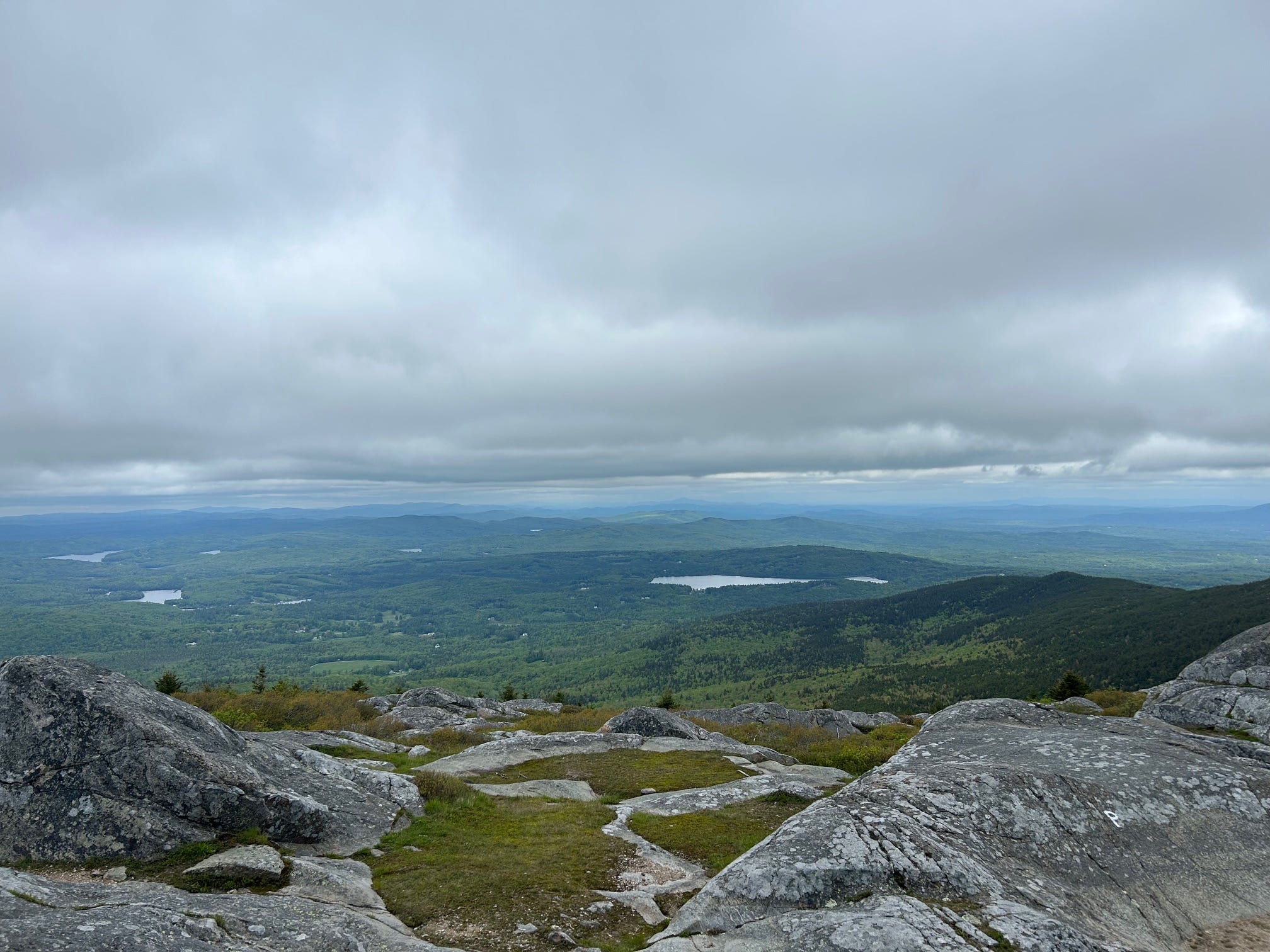
One of their preferred peaks for ritual exaltation was Monadnock, the 3,165-foot hump in the middle of southern New Hampshire. Its massive rocky cap is perhaps the greatest perch to see New England. The absence of any trees near the summit—fires in the early 1800s gave it a bald dome—reveals a panorama spanning from Rhode Island and Connecticut up to the northern reaches of the White and Green Mountains.
Somewhat inexplicably, Monadnock stands apart from these ranges. Ancient geological events left a hunk of earth far more prominent than any other in this sylvan swath of the region. The phenomenon of this peak was remarkable enough to be embedded in the language of the new nation that formed in its shadow. Derived from an Abenaki word, “monadnock” refers to an isolated mountain in English.
Emerson and Thoreau both sought its solitude. They made regular trips to the great mountain in New Hampshire. Each wrote about their experiences, but Emerson’s “Monadnoc” is the most recognizable tribute. At one point, the poem captures the particular allure of the mountain for those who find themselves living in their minds too much:
Bookworm, break this sloth urbane;
A greater spirit bids thee forth
Than the gray dreams which thee detain.
Gray dreams presided when I set off for Monadnock on a recent Thursday afternoon. Like so many others, I’d fallen into a trance of doomscrolling and other deleterious habits of digital addiction, and my capacity to sustain both attention and effort seemed to be diminishing rapidly. In this stupor, my productivity had waned, while my awareness of my work’s perceived diminishing value had heightened. Through intellectual theft, artificial competitors could now generate approximations of good writing in no time at all. They could research, synthesize, and deduce. They could summit, in other words, without the climb.
Still, they could not feel.
I wanted to reach Monadnock’s peak and glimpse that panorama for all the aesthetic and emotive reasons I remembered from past visits. But I really needed the climb to cleanse my thoughts. There are other remedies for mental lassitude—a long run, a good laugh—but few demand an endurance of attention and effort quite like a hike. Better to toil there than in the mind, I thought.
Under a gray sky, my gray dreams didn’t drift away immediately. A group from a prep school in Massachusetts was descending as I embarked, which reminded me of something I read on the internet: that, because of its proximity to Boston and other population hubs, Monadnock is the second-most-climbed mountain in the world, behind only Mount Fuji in Japan.
This “fact” struck me as dubious, based on my travels to teeming trails out West. And for a moment, my recollection of it returned my most pessimistic thoughts about the digital experiment and our tenuous relationship to truth.
But there was no denying that this mountain regularly attracted throngs to its foot, which made the uncrowded path upward on the day of my visit feel like a blessing. I soon succumbed to the spell of crunching boots and a beating pulse, and a familiar calm and clarity set in, distancing me from my fears.
For when I reached that craggy top, when I could see the sweep of New England once more, I knew the attendant exhaustion and thrill could only arise from such an ascent. This was what it meant, what it would always mean, to summit. There was no way past it.
I need to go climb a mountain. Thanks for reminding me!